
The task most operators face today is how to keep the subscriber base loyal. Stable high quality of broadcasting is one of the factors that helps address this challenge. To maintain high quality and detect violations in the stream, the monitoring system is required.
In this article, we will explain how to interpret a variety of metrics and parameters of TS and ES that will serve for quick fault identification and proactive error fixation. Among them are IP jitter (IAT, delay factor), media loss rate, multiple broadcasters event, TR101290, SCTE 35 marks, DTS and PTS timestamps, audio and video decodability, loudness EBU R 128, EPSNR.
There are some common cases IPTV and OTT operators experience and parameters that reveal the problems cause. To analyze the issues, we have used the Elecard Boro monitoring system. Elecard Boro is a client-server application consisting of 2 parts: a software Boro probe and a Boro server designed to collect and process statistics.
Case 1: Stuttering during ad breaks in region N
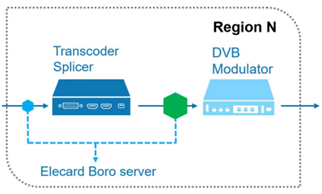
The probe detects the Video Information Changed event. This event happens quite often when inserting any kind of content. Parameters of regional advertising were different: aspect ratio was 16:9 instead of 4:3, and scan type was interlaced instead of progressive. Some other parameters can be different too, i.e. a codec or a frame rate. Some TV sets and STBs whose decoders cannot adapt to the dynamic change of parameters, stop decoding the picture and wait for the parameters to return to the previous values. Any changes on this level can affect proper decoding on the end-user device and significantly reduce the Quality of Experience for subscribers, especially if these changes are regular
Case 2: Stream becomes unavailable for еnd-users

Probes were installed after the satellite demodulator and after the transcoder. The monitoring system registered Program Specific Information Changed events. Also during these events Boro couldn’t decode audio (Audio Decodability event) and analyze loudness (Audio Loudness parameter). It was detected that descrambling module misbehaved from time to time and stopped descrambling. The scrambled stream resulted in faults of the transcoder.
Case 3: Problems with OTT channels – players stop working

Probes were installed before and after the transcoder/packetizer, after origin and after dozens of CDN servers in regions. Probes detected problems for a few of regional CDN servers: segments were absent or download rate was too low for real-time playback. The problem was identified: bandwidth between origin and regional servers was not sufficient.
Case 4: TV channels become unavailable or highly distorted
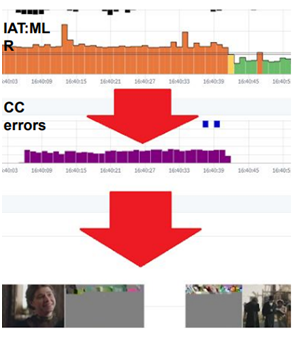
Probes were installed at the headend before the satellite modulator and across regions after the satellite demodulators. Boro detected a huge number of transport issues such as packet losses and CC errors in evening time. These losses made it impossible to decode a video and audio. The problem cause was interference between satellites.
Case 5: Subscribers of OTT service experience video freezes

Probes were installed before and after the transcoder/packetizer and after CDN servers. Several issues on transport level were detected. When CC errors appeared, the transcoder switched into the static picture mode. Sometimes after input stream recovery the transcoder did not switch back and streamed a static picture. The transcoder had to be rebooted.
What is Boro monitoring system?
Elecard Boro is a client-server application consisting of 2 parts: a software Boro probe and a Boro server designed to collect and process statistics. Boro probes are distributed over the network: at the head-end station, at input streams monitoring points and after transcoding, multiplexing and encrypting modules; at end-points of main delivery networks, signal distribution points and last mile locations. Boro probe detects violations in the stream and transfers the detailed statistical information to Elecard Boro server. The server aggregates the received data, provides reports in easy-to-understand graphic form, and ensures fast notifications about violations. Boro registers a great number of technical characteristics based on which one can make a conclusion on quality of TS streamed over the network. To make this information easy to read and understand, Elecard Boro offers different data layouts: events journal, graphs, multiscreen mode, Live View, tables etc.
Key tasks of Elecard Boro:
- Provides timely up-to-date information about services in a real-time mode;
- Verifies stream compliance with internal technical requirements and TELCO standards;
- Ensures availability of all streams across the network;
- Timely localizes network issues;
- Sends immediate notifications about detected violations;
- Automates and optimizes existing monitoring routines;
- Generates reports about service availability and network errors;
- Checks performance, quality and helps adjusting settings of video equipment;
- Performs load and stress tests of Content Delivery Network.
The monitoring system ensures prompt identification of network or content violations through probes that are distributed across different locations. It analyzes the identified events, determines the causes of errors, and aids in resolving the violations before they become noticeable to end-users. By tracking various parameters such as IP jitter (IAT, delay factor), media loss rate, multiple broadcasters event, TR101290, SCTE 35 marks, DTS and PTS timestamps, audio and video decodability, loudness EBU R 128, and EPSNR, monitoring systems guarantee a seamless high quality of broadcasting and enhanced subscriber engagement. For an effective monitoring solution, we recommend considering the use of the Elecard Boro monitoring system. This system records a wide range of streaming parameters (over 50 parameters and triggers) and offers flexible configuration options, quick deployment, a user-friendly interface, and other valuable features. Telco operators will find Elecard Boro to be an indispensable tool.
Visit Elecard at SetExpo show POD F to get you free demo version of Elecard Boro monitoring service with extended trial period.