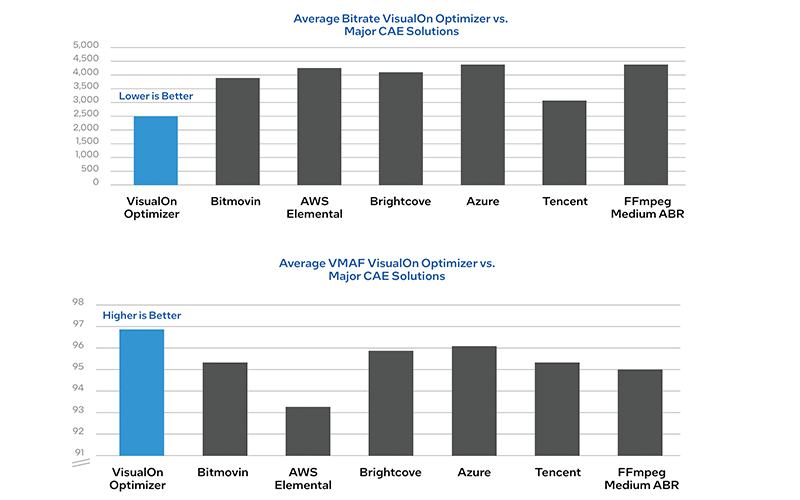
VisualOn and Intel announced a new white paper detailing breakthrough results in content-adaptive encoding (CAE), demonstrating how the VisualOn Optimizer can dramatically reduce streaming bandwidth while maintaining or enhancing video quality. Benchmark tests on Intel Xeon 6 SoC platforms show up to 40% average bitrate reduction and up to 9x improvements in transcoding efficiency across AVC, HEVC, and AV1 workflows.
The study highlights an AI-driven, single-pass CAE approach that dynamically adjusts encoding parameters on a per-frame and per-scene basis. This enables real-time live streaming and high-density transcoding without additional latency, helping media companies lower CDN, storage, and energy costs while delivering superior viewer experiences.
Designed to integrate seamlessly into existing FFmpeg-based workflows, VisualOn Optimizer is fully encoder-agnostic, supporting a wide range of infrastructure choices without locking customers into specific codecs or hardware platforms. This flexibility makes it ideal for streaming service providers, broadcasters, and studios seeking to modernize their video pipelines efficiently.
Key Highlights from the White Paper
– Up to 40% reduction in average bitrate with maintained or improved visual quality
– Real-time content-adaptive encoding for live and VoD workflows
– Encoder-agnostic support for AVC, HEVC, and AV1
– Improved transcoding density and operational efficiency on Intel® Xeon® 6 SoC
– Lower CDN, storage, and energy costs without disrupting workflows