By Marcelo Guerra, Senior Solutions Engineer and Customer Success at Uplynk
Streaming has never given media companies so many ways to build a workflow. Encoding can come from one provider, packaging from another, and ad insertion from a third. Then there are orchestration, monitoring, analytics, delivery, and playback.
That flexibility has helped the industry move faster. It has also created a level of operational complexity that few teams intended to build.
I have spent years operating large-scale streaming platforms and now work directly with media companies across Latin America. One pattern keeps emerging. Most complex workflows did not start out that way. They became so, one decision at a time.
A new vendor was added to solve a specific problem. A custom integration helped meet a launch deadline. Another component was introduced because the existing one could not support a new business requirement. Each decision made sense at the time.
Years later, the workflow reflects the history of those urgent decisions more than a single, intentional architecture. The individual components may work well, but ownership becomes unclear at the points where they connect. Those interfaces are often where the most difficult failures occur.
During a live event, the first question should be simple: what failed? In many environments, it is not simple at all. Teams can spend longer locating the problem than correcting it.
That delay quickly turns an engineering issue into a business problem.
Reliability comes before monetization
Commercial conversations about streaming usually begin with ad strategy, subscriber growth, audience engagement, or distribution. All of those subjects matter, but none of them can be separated from the quality and reliability of the service carrying the content.
Uptime alone is not enough. A stream can remain technically available even when ad insertion fails, playback quality degrades, or a syndication output disappears. From the platform’s perspective, the service may still be running. From the viewer’s or advertiser’s perspective, it is not delivering what was promised.
Ads generate revenue only when the entire chain works. Subscribers stay when the experience is consistent. Sponsors renew when the moments they paid to be associated with are delivered as promised.
The pressure is even higher in live sports, breaking news, and event programming. A replay may be available later, but the business value of the live moment cannot be recreated. If the stream fails during the goal, the final round, or the announcement everyone was waiting for, some of that revenue may be lost forever. Audience trust can take much longer to rebuild.
Reliability, therefore, is not a separate technical concern alongside the monetization strategy. It is part of that strategy.
What this means at Uplynk
Uplynk has delivered video since 2010. Over that time, the platform has supported live events, linear channels, VOD services, FAST channels, and monetization workflows at scale. The technology is an important part of that history, but it is not the complete answer. Operational confidence also stems from how the workflow is designed, monitored, and supported.
Our Solutions Integration team works with customers to build solutions around their specific requirements. That starts with understanding the sources, distribution targets, monetization model, operational responsibilities, and failure scenarios. The result should not be a generic template that leaves the customer to connect the remaining pieces.
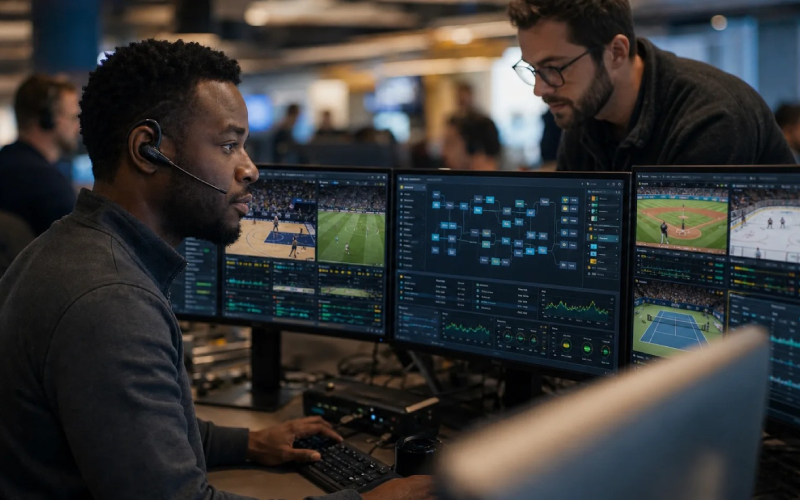
StreamOps adds an active operational layer through pre-event validation, event management, and eyes-on-glass monitoring during broadcasts. It does not eliminate the possibility of failure. Nothing can. What it changes is how early a problem can be detected, how much context is available, and how quickly the right people can respond.
Technical Account Managers provide continuity. They understand the customer’s workflow, its history, and the rationale behind previous decisions. As the operation evolves, the conversation does not need to start from scratch.
Together, these capabilities form what we describe as Build, Run, and Support. They surround the platform with people who understand the workflow as a whole and remain accountable beyond the boundaries of an individual component.