For years, the next generation of over-the-air television has been presented as a transformation on the horizon: a more connected, interactive, and personalized television experience, combining the scale of terrestrial broadcasting with the flexibility of the internet.
Now, that transformation is beginning to reach the Brazilian market. As DTV+, Brazil’s implementation of TV 3.0, moves forward, the first compatible receivers are starting to bring this new television architecture into products reaching consumers. As part of this transition, Mirakulo’s AstroTV NEXT arrives as a pioneering TV 3.0 middleware platform.
More than an evolution of traditional digital television, TV 3.0 represents a shift in the way content is presented and consumed. The experience combines broadcast and broadband within a single platform, bringing together the reach and reliability of terrestrial broadcasting with the flexibility of connected services.
This convergence is where AstroTV NEXT comes in.
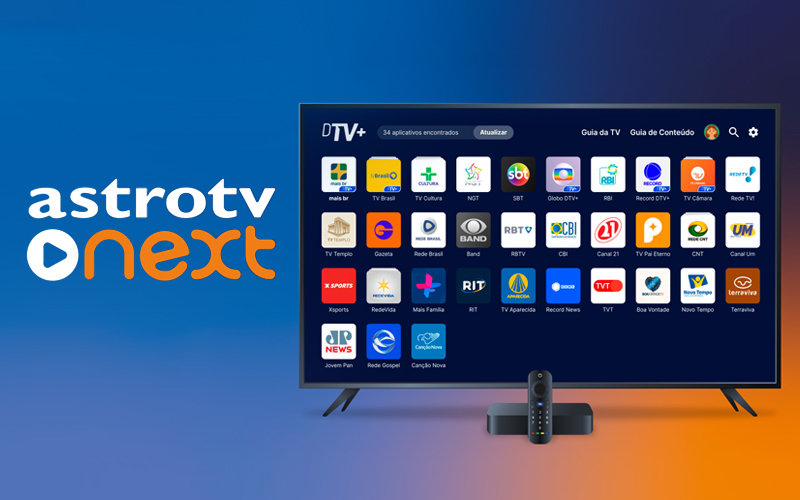
The platform integrates the terrestrial broadcast environment with the TV’s connectivity while maintaining integration with the device’s tuner and enabling an application-based experience. Channels can be presented as apps, while broadband capabilities expand the possibilities for interactivity, complementary content, and connected services.
AstroTV NEXT brings together features such as 4K video, immersive audio, DTV+ HTML5, targeted advertising through Dynamic Ad Insertion (DAI), profile creation, and audience measurement, exploring the different possibilities enabled by TV 3.0.
This new architecture also expands the role of middleware. While in traditional television middleware primarily serves as a software layer for running digital TV applications, in this new environment it integrates multiple elements of the television experience, including the tuner, broadcast, broadband, applications, data, and services.
For viewers, this means a navigation experience closer to what they are accustomed to on connected devices, without giving up over-the-air television. Organizing channels as applications creates a new way to discover and access content, while connectivity makes it possible to incorporate services and experiences that go beyond linear programming.
For broadcasters and other participants in the ecosystem, the combination of broadcast and connectivity opens up new opportunities for interactivity, audience measurement, personalization, and monetization. Technologies such as DAI enable targeted advertising to be delivered over an internet connection, while profile creation allows for more personalized experiences.
Although its first implementation is within Brazil’s DTV+ ecosystem, AstroTV NEXT was also developed with the international market in mind. The platform is compatible with both DTV+ and ATSC 3.0, supporting the evolution of over-the-air television across different markets.
The arrival of the first DTV+-compatible products therefore represents an important milestone for the entire ecosystem. TV 3.0 is beginning to move beyond specifications and technology demonstrations to become a platform that can effectively reach consumers’ homes.
This is where AstroTV NEXT positions itself: turning the capabilities of TV 3.0 into a tangible, interactive, flexible, and personalized experience for consumers.
The next generation of over-the-air television has already begun, and AstroTV NEXT is here to be part of that transformation.