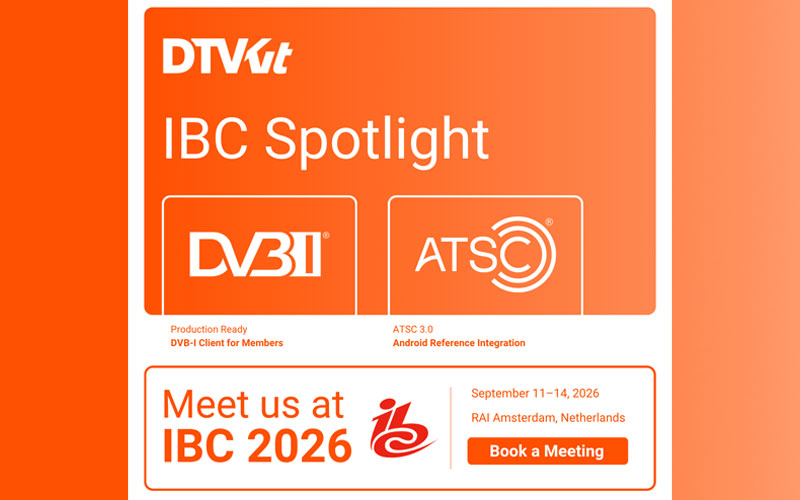
Following the successful launch of its production-ready DVB-I Client earlier this year, DTVKit will showcase the technology with Ocean Blue Software at IBC 2026, with a live demonstration at the Ocean Blue Software stand.
The demonstration will give broadcasters, operators, TV manufacturers, and technology providers a first-hand look at how DVB-I can be deployed using a practical, standards-compliant implementation designed to accelerate commercial adoption.
Developed collaboratively by DTVKit and Ocean Blue Software, the DVB-I Client is available to DTVKit members as a shared-source, royalty-free solution, delivering a highly portable and efficient implementation suitable for smart TVs, set-top boxes, and next-generation hybrid television platforms.
As DVB-I moves from industry trials into commercial deployment, manufacturers are increasingly seeking production-ready solutions that simplify integration, reduce development effort, and ensure compliance with evolving standards. The live IBC demonstration will show how the jointly developed implementation enables rapid DVB-I adoption while maintaining platform flexibility and low resource requirements.
A production-ready DVB-I implementation
The DTVKit DVB-I Client is implemented in native C++ for maximum portability, efficiency, and minimal memory consumption. The client exposes a JSON-based API, enabling seamless integration with web-based user interfaces and applications across a broad range of operating systems and device platforms.
Key capabilities include:
– Shared-source, royalty-free DVB-I client available to DTVKit members.
– Native C++ implementation designed for portability and low resource usage.
– JSON API for integration with modern web-based user interfaces.
– Compliance with DVB-I BlueBook A177r7 requirements.
– Platform-independent architecture suitable for Android, Linux, RDK and other browser-capable environments.
Live IBC demonstration
Visitors to the Ocean Blue Software stand will see the DVB-I Client integrated with a React-based web user interface running on the DTVKit Android reference set-top box platform.
The demonstration will showcase how users can: Discover DVB-I service lists with region selection; Browse channels and services; View programme guide (EPG) information; Access accessibility and parental-control metadata; Play IP-delivered linear television services; Navigate and launch on-demand boxsets and launch linked HbbTV and web applications.
The demonstration highlights the flexibility of DTVKit’s architecture, which separates the DVB-I client from the presentation layer through a standards-focused JSON interface.
Built for flexibility beyond Android
Although the demonstration runs on DTVKit’s Android reference platform, the implementation itself is not Android-specific. The web-based user interface communicates with the DVB-I client through a platform-independent JSON API, enabling deployment across a wide range of browser-capable environments.
The demonstration intentionally does not use the Android TIF/TIS framework, showcasing an integration model that can be readily adapted to different operating systems and middleware environments.
Supporting the future of DVB-I
DTVKit continues to track developments within DVB and is actively following the DVB-I roadmap, including support for future specification updates. Members receive full source-code access to the DVB-I Client together with royalty-free distribution rights, allowing manufacturers to adapt and deploy the technology according to their specific product requirements.
Commenting on the industry’s progress, Amy Cleary, Managing Director of DTVKit, said: «The industry is now moving beyond DVB-I evaluation and into practical deployment. At IBC, we’re demonstrating a real implementation that manufacturers can integrate today. By combining a lightweight C++ client with a modern web-based UI architecture, we’re giving members a flexible and cost-effective route to DVB-I adoption across multiple device platforms.»
The live demonstration at IBC 2026 reflects this focus on practical implementation, showing how manufacturers can accelerate deployment while maintaining flexibility across operating systems and middleware environments.
Paul Martin, CEO of Ocean Blue Software, added: «IBC provides the perfect opportunity to demonstrate how DVB-I can be implemented in a practical, standards-compliant way. Working with DTVKit, we’ve focused on creating a solution that helps manufacturers reduce complexity and accelerate deployment while maintaining the flexibility needed for future services.»
See the demonstration at IBC2026
Visitors can experience the live DVB-I demonstration throughout IBC 2026 on the Ocean Blue Software stand in Hall 1.B25, where experts from both companies will be available to discuss implementation approaches, integration options, and the future evolution of DVB-I services.