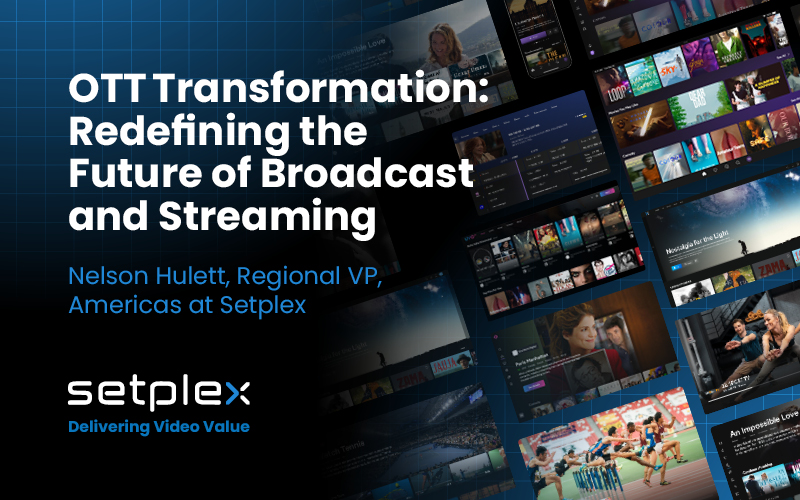
By Nelson Hulett, Regional VP, Americas at Setplex
Over the past two decades, video consumption has undergone a profound transformation. With the rise of connected devices — from smart TVs and smartphones to tablets, laptops and even connected vehicles — users are no longer tied to the living room or limited by programming schedules. Content consumption has become mobile, on-demand and entirely user-driven.
This shift is redefining how operators engage with their audiences. For operators and broadcasters navigating the OTT era, understanding these behavioral changes is key to improving the user experience, retaining audiences, optimizing decision-making and staying competitive in an increasingly flexible and personalized environment.
The Audience Revolution
Until the early 2000s, cable and satellite television dominated home entertainment. Programming schedules dictated viewing habits, and audiences adjusted their routines to the constraints of linear broadcast models. That world has changed dramatically.
According to PwC, approximately 70% of households in Latin America already have access to streaming services. The era of “one-size-fits-all” television is over.
The disruption of social media introduced something that streaming platforms quickly adopted: flexibility and content personalization. Audiences gained control. The role of the programmer — deciding what and when people could watch — effectively disappeared. Today, users can watch what they want, when they want and on the device of their choice.
Equally important, these platforms offer personalization. Recommendation engines analyze viewing behavior and suggest content aligned with individual preferences. The same applies to advertising, which is now highly targeted.
For audiences, this is simply the new normal. For operators, however, it introduces a new level of complexity in data management, workflows and decision-making.
Why OTT Is Much More Complex Than Internet TV
Despite the clear growth of streaming, some still define OTT as simply traditional television delivered over IP networks. In reality, operating in this environment requires new approaches to platform architecture, user experience design, data analytics and monetization models. It also demands a fundamental shift in mindset.
Operators must be able to deliver live and on-demand content across any device, offer personalized recommendations, capture real-time behavioral data and scale globally without continuously expanding physical infrastructure.
The Uncomfortable Truth of Transformation
OTT transformation is often presented as a relatively straightforward technical migration. In practice, it represents a deep restructuring that impacts infrastructure, operations, monetization and, above all, organizational culture.
Any transformation must begin with an honest assessment of the operator’s current environment. It is critical to clearly understand existing infrastructure, its capabilities and its limitations before planning expansion.
For many operators, the biggest challenge lies in legacy systems. Customer management platforms designed for mass audiences often struggle to support personalized digital services. Billing systems based on rigid packages do not always allow for monthly or hybrid models. Promotional tools often operate independently from user behavior data.
Replacing these systems entirely is rarely feasible. Most operators must rely on a coexistence model: integrating new OTT layers while maintaining legacy infrastructure during the transition.
However, coexistence is temporary. For transformation to succeed, legacy systems must have a clearly defined end-of-life timeline.
The Cultural Shift
While technical challenges are significant, the most profound impact of OTT transformation is human.
Engineering teams must move from maintaining stable broadcast signals to managing multi-device IP experiences, with new performance metrics such as buffering ratios, startup times, device-specific failures and session performance. The shift is from the familiar territory of broadcast spectrum to the unknown world of cyberspace.
Marketing teams must move away from mass campaigns and embrace hyper-segmentation, A/B testing and real-time feedback loops. In the past, everything ended with ROI; today, campaigns are continuously optimized and restarted.
Commercial teams must also adapt to a data-driven advertising economy, where impressions, clicks and audience segmentation replace traditional ratings. In this environment, advertising shifts toward programmatic models, where the audience — not airtime — becomes the primary currency.
Departments that once operated independently must now collaborate around shared data and insights. OTT transformation redefines not only technology, but also organizational culture.
From Distribution Platform to Data-Driven Business
Once an OTT service is launched, many operators believe the hardest part is over. In reality, the real challenge begins after launch. OTT operations are not just distribution channels — they are data-driven digital businesses.
For the first time, operators can build direct relationships with individual users. They are no longer working with abstract audiences, but with real users whose behaviors and patterns can be identified. Operators know what users watch, when they watch, how long they stay and when they leave the platform.
This data introduces three critical operational layers:
- Quality of Service (QoS): Measures technical platform performance. Metrics such as startup time, buffering levels, device failures and session stability help identify issues before they impact users.
- Quality of Experience (QoE): Evaluates how users interact with the service. Registration flows, payment simplicity, content discovery, viewing duration and engagement define user perception.
- Acquisition Analytics: In OTT environments, every acquisition campaign is fully measurable. Operators can track where users come from, how much it costs to acquire them and whether they remain active over time.
In this context, marketing shifts from a cost center to a measurable investment, driven by metrics such as customer acquisition cost (CAC), lifetime value (LTV) and retention. Inbound marketing tools — including automation, segmentation, nurturing and retargeting — become essential. Campaigns are no longer justified by reach or impressions, but by return on investment (ROI).
Beyond OTT Transformation: The Opportunity Ahead
OTT transformation is not simply a technological migration or a response to cord-cutting. It is an opportunity to rethink how content is distributed, how audiences are built and how value is created in media businesses.
Launching an OTT platform is only the beginning. Sustained success depends on the operator’s ability to measure performance, interpret data and continuously optimize the user experience.
Operators that approach this transition with flexible platforms and a genuine willingness to adapt will not only survive the streaming era — they will help define it.
In today’s media ecosystem, the difference between an OTT platform that merely exists and one that truly grows comes down to a single capability: measuring and understanding the audience.